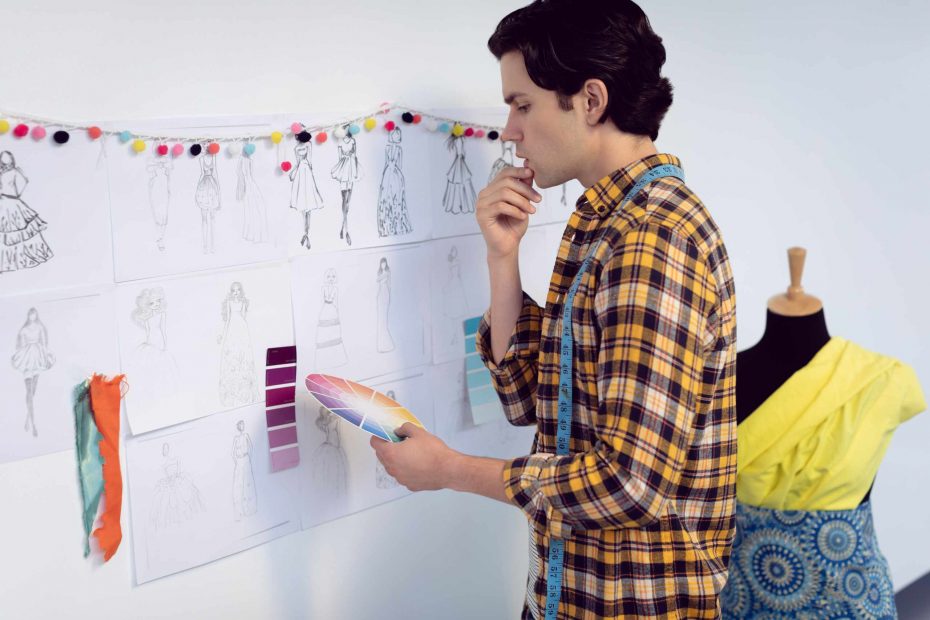
You don’t need to turn your fashion sketch into a fancy illustration to make it work. In a beginner clothing design class, the only role a sketch is supposed to play is explaining the idea of your garment in a way that makes it possible for a person to see what its form looks like, know its most important points, understand the direction of its material, and maybe guess what its fit might be. You can work on the beauty of your drawing at another time. You must read the sketch first.
The simplest way to ensure your sketch is more readable is to separate the sketching of your figure from planning your garments. You can use your basic figure as a very basic garment template, or even just a faint, general outline that highlights the key points of the shoulders, waist, hips, arms, and legs. This draws the focus away from details in the figure that aren’t related to the clothing, like the features of the face, hair, pose, or even the details of the shading. If your figure is too busy, what ends up happening is the design of your garments, even if it looks impressive on the page, may be less effective because it looks less obvious. It is always better for your beginner sketch to be a straightforward front view rather than an interesting pose that is more attractive than it is helpful.
The most likely point where beginners get annoyed in their fashion sketches are in their proportion, when, for example, the length of the sleeves is too long, or the placement of the pockets is too high, or the neckline looks nice but doesn’t seem to match the rest of the garment shape. Rather than completely erasing your sketch and starting over you can instead just add in a few guiding lines to help you get the proportions right. You can lightly sketch a horizontal line where the waistline is going to be located, another for the position of the hips, and then one more for your desired length of the hem.
You can also do a more focused sketch check after you sketch out your first fashion draft. For example, you could cover the middle of your design with a piece of paper that focuses only on its outside edge and ask yourself whether you can determine at a glance if the garment is a long or a short piece, or if it is a looser or slimmer one, or whether it is structured or unstructured. You could then remove the piece of paper and look over the middle of your design, asking if what you can see of the seams or necklines, the sleeves, or the pockets supports your earlier conclusion, or if it actually makes it less readable. This short pause can help you realize if you are in fact adding extra decoration to your garment when in fact it might be better for you to focus on making your sketching of the main design lines more clear.
You might also make your beginner fashion sketch more useful by adding some labels to it, either next to or inside of the drawing. You might for example, write a couple of lines next to your fashion sketch that say something about the weight of the fabric, how the material drapes, the position or length of the zipper, or if it has an extra detail like wide sleeves, a round hem, or patch pockets. This doesn’t detract from your fashion sketch, but rather it allows you to give information that you may not know how to show in your lines, like the weight of the fabric, the texture, or how it closes or fits, as a drawing that has a bit of label information on it may be far more helpful to someone than a drawing that shows no idea of the fabric weight, or if it has any texture at all, or anything about its closure or the fit.
Being able to read your fashion sketch gives you the ability to make changes to it. Now that you can see your basic shape, you can understand the notes about the fabric, and you can see the most important design details of your garment, you can then ask yourself more precise questions, for example, does this neckline look too wide for how the garment will function? Is the line of your hem appropriate for the type of draping the fabric has? Is it easier to reach into your pockets? Is one embellishment or piece of trim enough, or is it too many? Your sketch is now actively working to create a design if it allows for you to ask questions like these, even if you are just beginning to sketch out your ideas.